What is a Scheduled Caste?
India is defined by its composite population, creating a vast pluralistic landscape shaped by diverse religious, linguistic, cultural, ethnic, and socio-economic dynamics. Among the historically and economically marginalized groups, the Scheduled Castes (SCs) hold a distinct constitutional position. Under the Indian constitutional framework, this group is explicitly recognized to insulate its members from historical forms of discrimination and structural exploitation, while simultaneously serving as a mechanism to uplift their socio-economic status. This recognition goes beyond mere categorization; it acts as a mandatory constitutional mandate that drives the state to implement targeted affirmative action, enforce protective laws, and deploy welfare policies designed to elevate these communities into the mainstream socio-economic fabric of the nation. Specifically, Article 366(24) of the Constitution defines Scheduled Castes as follows:
“Scheduled Castes means such castes, races or tribes or parts of or groups within such castes, races or tribes as are deemed under Article 341 to be Scheduled Castes for the purposes of this Constitution”
Under Article 341(1), the President is empowered to issue a public notification specifying the castes, races, or tribes, or groups within them, deemed to be Scheduled Castes in relation to a specific State or Union Territory. Where a State is concerned, the exercise of this power is subject to mandatory consultation with the Governor of that State. To safeguard the integrity of this list against political manipulation and executive overreach, Article 341(2) strips the executive of any subsequent power to alter it. Once the initial Presidential notification is published, it cannot be amended by any later executive order; the power to include or exclude any caste, race, or tribe rests exclusively with Parliament through legislative enactment. It was under this precise constitutional architecture that the foundational lists were established. The President first issued The Constitution (Scheduled Castes) Order, 1950 for States and The Constitution (Scheduled Castes) (Union Territories) Order, 1951 for Union Territories. Over the decades, Parliament has regularly used its exclusive authority to update these lists to match changing ground realities. The most recent updates were made through parliamentary amendment acts in 2024.
The Constitutional Framework
To dismantle systemic inequalities, the Constitution of India deploys a multi-pronged strategy that spans fundamental rights, socio-economic guarantees, and political safeguards:
Protection Against Discrimination (Article 15): Prohibits the State from discriminating against any citizen on grounds only of religion, race, caste, sex, or place of birth, while explicitly permitting special provisions for the advancement of socially and educationally backward classes.
The Abolition of Untouchability (Article 17): Abolishes the historical practice of “untouchability” in any form and declares the enforcement of any disability arising out of it to be a punishable offense.
Reservation in Public Employment (Article 16): Guarantees equality of opportunity in public services while empowering the State to make reservations in appointments or posts in favor of backward classes that are underrepresented in the services.
Political Representation in Legislative Bodies (Articles 330 & 332): Secures democratic representation by reserving seats for Scheduled Castes in the Lok Sabha (Parliament) under Article 330 and in the respective State Legislative Assemblies under Article 332.
Statutory Safeguards
While the Constitution provides the structural foundation, Parliament has enacted specialized, stringent legislation to enforce these rights and penalize targeted exploitation:
The Protection of Civil Rights Act, 1955: Originally enacted as the Untouchability (Offenses) Act, this statute prescribes penalties for enforcing social disabilities linked to the historical practice of untouchability.
The Scheduled Castes and the Scheduled Tribes (Prevention of Atrocities) Act, 1989: A robust criminal statute enacted to curb hate crimes, prevent institutionalized humiliation, and ensure swift justice and rehabilitation for victims of targeted atrocities committed by non-SC/ST individuals.
What Happens to SC Status Upon Conversion
Paragraph 3 of both the Constitution (Scheduled Caste) Order, 1950 and Constitution (Scheduled Caste) (Union Territories) Order, 1951 provides that that no person who professes a religion different from the Hindu, the Sikh, or the Buddhist religion can be deemed to be a member of a Scheduled Caste. For easy reference, the provision is reproduced below:
“Notwithstanding anything contained in paragraph 2, no person who professes a religion different from the Hindu, the Sikh or the Buddhist religion shall be deemed to be a member of a Scheduled Caste.”
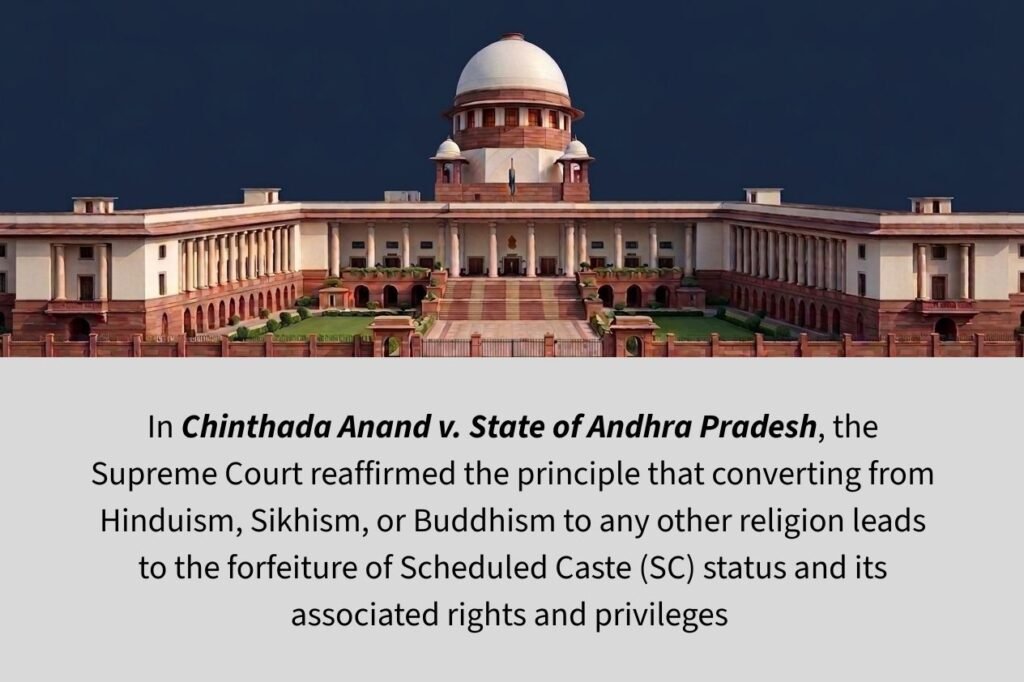
Recently, in Chinthada Anand v State of Andhra Pradesh, [1] the Supreme Court held that the stipulation provided under Paragraph 3 of the Constitution (Scheduled Caste) Order, 1950 is absolute and conversion to any religion which is not specified in the same results in an immediate and complete loss of SC status from the moment of such conversion regardless of birth. And, as a result, a person who is legally not an SC anymore, cannot claim any statutory or constitutional protection, reservation, entitlement or benefit that is predicated upon the membership of such person to SC. Therefore, to be officially recognized as an SC in India, an individual’s caste must be specified under Paragraph 2 of the Constitution (Scheduled Castes) Order, 1950. Additionally, under Paragraph 3, they must profess Hinduism, Sikhism, or Buddhism. In light of the decision, it is imperative to understand the following:
1. What Does “Caste” Mean?
combines members of different castes into a distinct body which becomes a new caste. Migration to another place makes sometimes a new caste as observed by the High Court of Madras in Muthusami v. Masilamani [4].
2. Why Does the Order Include Sikhism and Buddhism if Caste is Predominantly a Feature of Hindu Society?
In Punjabrao v. D.P. Meshram [5], the Supreme Court interpreted “profess” in the 1950 Order to mean an open, public declaration or practice of a specific faith, ruling that a public avowal of entering a new religion is sufficient legal proof of identity. The Court emphasized that once an open declaration is made, it is unnecessary to examine the theological efficacy or sincerity of the conversion; consequently, if an individual publicly declares they have ceased to follow a permitted religion, they lose their Scheduled Caste benefits. This principle was reinforced in Chinthada Anand (supra) where the Court clarified that to profess requires an outward manifestation rather than a mere private conviction. Therefore, open actions that display a change in faith, such as publicly serving as a religious minister or pastor for a non-recognized religion, constitute a clear declaration that disqualifies an individual from claiming status under the Order.
Can a Person Simultaneously Profess Multiple Religions?
The Court in Chinthada Anand (supra) explicitly held that a person cannot simultaneously profess and practice a religion other than the ones specified in Clause 3 of Constitution (Scheduled Castes) Order, 1950 and claim membership of a Scheduled Caste at the same time. A person who professes and practices such religion for personal, social and spiritual purposes cannot in law, assert membership of a Scheduled Caste for the purpose of securing statutory benefits. The two positions are mutually exclusive and contrary to the Constitutional scheme.
Reconversion and the Restoration of SC Status
Under the Constitution (Scheduled Castes) Order, 1950, an individual seeking to reclaim Scheduled Caste (SC) status upon reconverting to Hinduism, Sikhism, or Buddhism from an excluded religion faces a strict, non-negotiable evidentiary burden. The claimant carries the entire onus of proof and must cumulatively satisfy three mandatory conditions; failure to establish even a single prong will completely invalidate the claim:
Proof of Scheduled Caste Origin: The claimant must provide clear, irrefutable proof that they originally belonged to a specific caste explicitly notified under the Constitution (Scheduled Castes) Order, 1950, prior to their initial conversion.
Bona Fide Reconversion and Cultural Re-adoption: There must be credible, unimpeachable evidence of a genuine reconversion, marked by the total and unequivocal renunciation of the interim religion. The individual must demonstrate complete dissociation from the previous faith alongside the actual adoption and active observance of the customs, usages, rituals, and religious obligations of their original caste.
Community Acceptance and Assimilation: The claimant must present satisfactory evidence demonstrating that they have been consciously accepted and assimilated back into the original caste and concerned community. Mere self-proclamation of one’s identity is legally insufficient; the community itself must formally recognize and accept the individual as one of their own.
- 2026 SCC OnLine SC 466
- ILR 33 Mad 67
- (1976) 1 SCC 863
- ILR 33 Mad 342
- 1964 SCC OnLine SC 76