~S.M. Sikri
What is a Preamble?
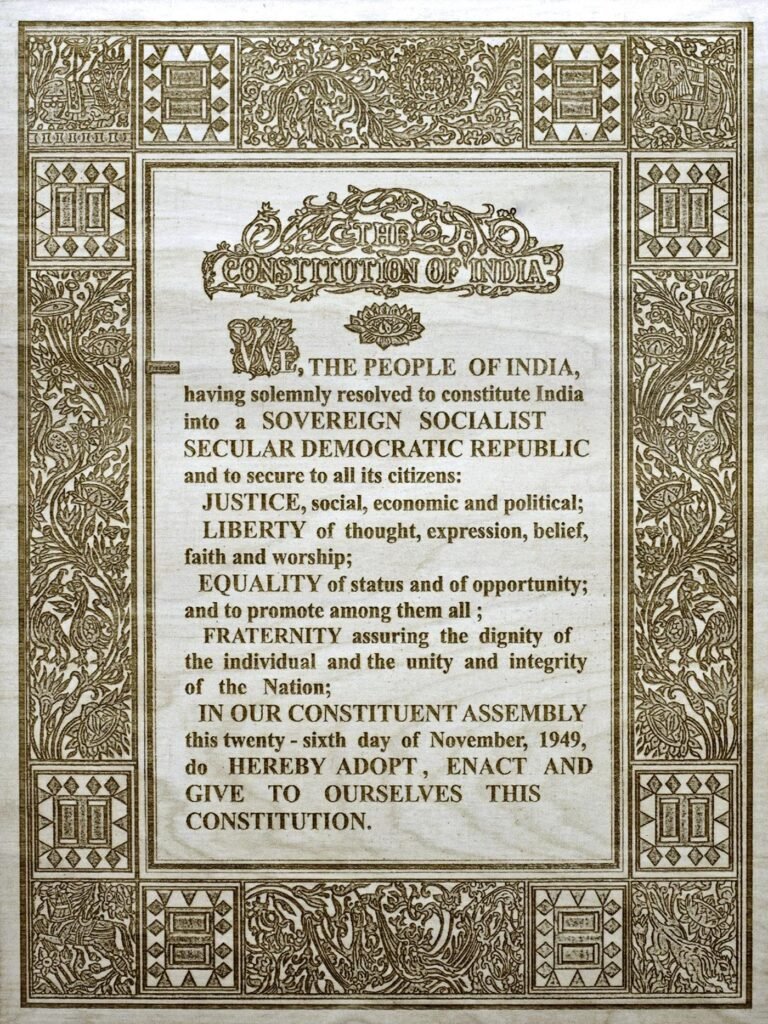
A preamble refers to an introductory statement that highlights the core philosophy, objectives and values of a legal document, commonly functioning as the key to the mind of the legislators. The practice of prefixing legal instruments with a preamble originated with the Constitution of the United States in 1789. This drafting tradition became a widely accepted international practice, offering a clear framework to capture a legislature’s core intent when framing any statute or Constitution. For instance, this practice of incorporation of a preamble was introduced in colonial India through enactments like the Indian Contract Act of 1872, and the approach was later embraced by the Constituent Assembly, which debated and finalized the Preamble to the Indian Constitution on October 17, 1949. The Preamble was then adopted on 26th November, 1949 along with the rest of the Constitution.
What does Preamble of the Indian Constitution Specify?
The Preamble to the Constitution of India uniquely specifies the following four components that form the core of India’s constitutional order:
- Source of Sovereignty: Opening with “We, the People of India” and culminating in “adopt, enact and give to ourselves this Constitution,” the Preamble establishes that ultimate power resides in the citizens. The Constitution, along with every organ of government, derives its supreme legitimacy directly from their collective will.
- Nature of the Polity: It declares India to be a Sovereign, Socialist, Secular, Democratic Republic, defining both the moral character and structural framework of the state. The words socialist and secular were added by the Parliament vide 42nd Constitutional Amendment Act, 1976.
- Core Objectives: The Constitution guarantees its citizens Justice in all its forms (social, economic, and political); Liberty of thought, expression, belief, faith, and worship; Equality of status and opportunity; and Fraternity to nurture a shared sense of unity and national dignity.
- Date of Adoption: The Constituent Assembly formally adopted the Constitution, along with its Preamble, on November 26, 1949, a milestone now commemorated annually as Constitution Day. While this marked the completion of the drafting process, the Constitution fully came into force on January 26, 1950, a date chosen to honor the historic Purna Swaraj declaration of 1930.
Historical Foundations of the Preamble & Its Principles
Concept and Opening Phrase: The phrase “We, the People of India” was adopted from the Constitution of the United States, anchoring ultimate constitutional authority in the collective sovereignty of the citizenry.
Core Objectives: The overarching philosophy and rights framework were derived from the historic Objectives Resolution introduced by Pandit Jawaharlal Nehru on December 13, 1946, which drew inspiration from major global revolutions:
Justice: The pledge to secure social, economic, and political justice was inspired by the Russian Revolution of 1917.
Liberty and Equality: The guarantees of liberty and equality were drawn from the French Revolution of 1789.
Fraternity: The concept of fraternity was integrated from the French revolutionary triad to foster social cohesion and national integrity.
Overall Language: While the substantive values were rooted in the Objectives Resolution and revolutionary ideals, the structural arrangement, linguistic phrasing, and draftsmanship were modeled after the Australian Constitution.
Whether Preamble is Part of the Constitution or not?
The Preamble offers an essential insight into the minds of the Constitution’s framers, yet its precise legal status remained a subject of intense judicial debate for decades. The following landmark cases chronologically trace how the Supreme Court settled this issue, offering key observations on the Preamble’s interpretive value and place within the constitutional framework:
In Re: Berubari Union and Exchange of Enclaves [1]
Kesavananda Bharati v. State of Kerala [3]
- Status as Part of the Constitution: The Court held that the Preamble is an integral part of the Constitution. It holds extreme importance and must guide the interpretation of the entire text, as it embodies the grand and noble vision of the framers. Because it was enacted and adopted after the rest of the Constitution had been finalized, it acts as a key to understanding the instrument. Consequently, it serves as a vital interpretive tool whenever a provision presents ambiguity or admits of two plausible meanings.
- Role in Delineating the Basic Structure: The Bench observed that the broad contours of the fundamental features or basic elements of the Constitution are explicitly outlined in the Preamble. Identifying these core elements is largely straightforward because one need only look to the Preamble itself. Furthermore, the term “amendment of the Constitution” in Article 368 was interpreted to mean any addition, variation, or repeal of a provision within the framework of the Preamble, designed to fulfill the objectives set out in the Preamble and the Directive Principles of State Policy.
- Source of Implied Limitations: The Preamble is neither an independent source of substantive power nor a standalone limitation on legislative action. However, it functions as a guiding compass to identify the unamendable Basic Structure of the Constitution.
- Amendable under Article 368: Since the Preamble is a part of the Constitution, it is subject to the amendatory process under Article 368 just like any other provision. However, this power remains constrained by the Basic Structure doctrine: while ordinary aspects of the Preamble may be amended, its core principles, such as the Sovereign, Democratic, and Republic character of the polity, along with the foundational objectives of Justice, Liberty, Equality, and Fraternity—constitute the unamendable bedrock of the Constitution.
Indira Gandhi v Raj Narain [4]
Is Preamble Non-Justiciable?
Amendment of the Preamble
- In Re: Berubari Union and Exchange of Enclaves, 1960 SCC OnLine SC 23.
- I.C. Golaknath v State of Punjab, 1967 SCC OnLine SC 14.
- Kesavananda Bharati v State of Kerala, (1973) 4 SCC 225.
- Indira Gandhi v Raj Narain, (1975) (Supp.) SCC 1.
- Minerva Mills v. Union of India, (1980) 3 SCC 625.
- Dr. Balram Singh v. Union of India, 2024 SCC OnLine SC 3433.