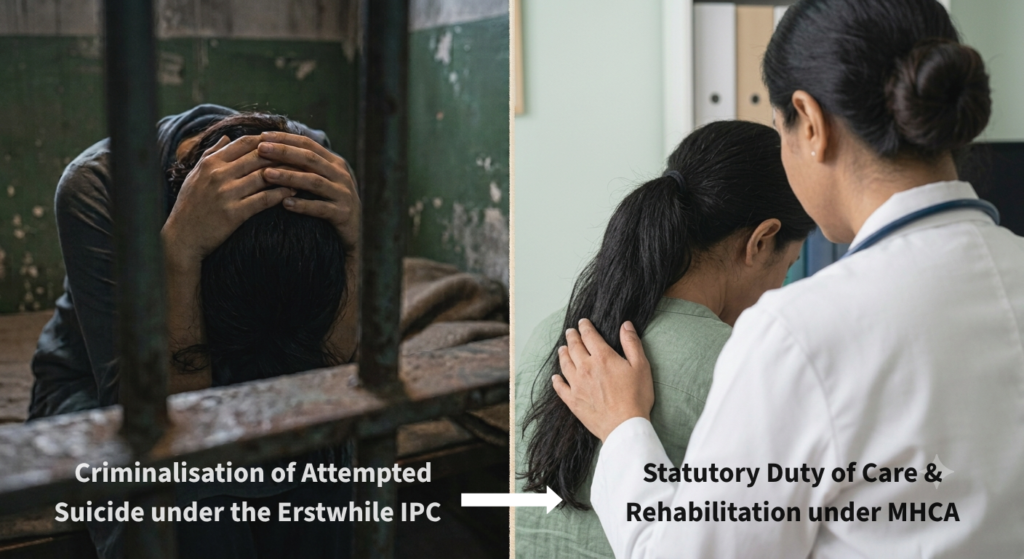
The erstwhile Section 309 of the Indian Penal Code, 1860 (IPC) carried the colonial legacy of criminalizing attempt to suicide in India. However, as our socio-legal jurisprudence progressed and embraced a more humanized outlook, an attempt to suicide came to be recognized not as a crime, but as a mental health crisis requiring medical intervention and rehabilitation. This compassionate approach was formalized through the landmark Mental Healthcare Act, 2017 (MHCA) which effectively decriminalized attempt to suicide and placed a mandatory statutory duty on the state to promote mental health awareness and implement comprehensive suicide prevention programs. To fully appreciate this transformation, it is essential to trace the jurisprudential evolution of Section 309 of the IPC alongside the changing judicial interpretation of Article 21.
Theoretical Foundations: Understanding Suicide
Loss of Human Capital: The state views individuals as essential economic and social resources whose self-destruction deprives society of valuable productive capacity.
Societal Ripple Effects: Beyond individual loss, suicidal acts generate severe psychological and socio-economic trauma for surviving family members, dependents, and the surrounding community.
Legal Deterrence: Penal codes historically operated on the assumption that criminal prosecution deters future attempts, a premise now widely criticized as misplaced, as legal threats cannot dissuade deep emotional or mental crisis.
Although contemporary global legal standards have largely evolved to treat suicide as a public health issue rather than a crime including India, however, several countries still retain punitive laws against attempted suicide like Afghanistan, Pakistan, Bangladesh, Singapore etc.
The Evolution of Indian Law on ‘Attempt to Suicide’
Section 309 of IPC reads as:
“Whoever attempts to commit suicide and does any act towards the commission of such offence, shall he punished with simple imprisonment for a term which may extend to one year or with fine, or with both.”
The legal debate around Section 309 of the erstwhile Indian Penal Code (IPC) gained momentum with the Bombay High Court’s landmark ruling in Maruti Shripati Dubal v. State of Maharashtra [2]. The High Court struck down Section 309 as unconstitutional for violating both Articles 14 and 21 of the Indian Constitution. Relying on the foundational logic established in R.C. Cooper v. Union of India [3] which held that what is true of one fundamental right, must be true for others, the Court reasoned that explicit freedoms inherently contain their negative aspects. Just as the freedom of speech includes the right to remain silent, and the freedom of association includes the right not to join one, the Court concluded that the right to live under Article 21 logically encompasses a right to die or a right not to live a forced life. The Supreme Court subsequently addressed the issue in P. Rathinam, where a Division Bench upheld the central reasoning of the Bombay High Court by declaring Section 309 violative of Article 21, though it found no violation of Article 14. The Bench emphasized that suicide stems from deep psychological distress rather than criminal intent (mens rea). Consequently, the traditional penal theory of deterrence fails entirely, as a person driven to end their life will not be deterred by the threat of imprisonment.
The legal precedent set by P. Rathinam was short lived, as a Five Judge Constitution Bench of the Supreme Court overruled it in Gian Kaur v. State of Punjab [4]. The Constitution Bench definitively held that Section 309 IPC is constitutionally valid under Article 21, affirming that the “right to life” cannot, by any stretch of imagination, be interpreted to include a “right to die.” The Court highlighted the State’s compelling interest in preserving the sanctity of human life, noting that Article 21 focuses on protecting life rather than permitting its deliberate extinction. Along with Section 309, the Court explicitly re affirmed the constitutional validity of Section 306 IPC, which penalizes the abetment of suicide as an independent offense. It is pertinent here to note that although the constitutional validity of Section 309 IPC stood firm post Gian Kaur, the Court had not considered the viability of attempt to suicide as an offence. The policy landscape shifted significantly following the Law Commission of India’s 210th Report in 2008, titled “Humanization and Decriminalization of Attempt to Suicide.“ While the offense remained on the statute books for over two decades, the enactment of the MHCA effectively neutralized Section 309 in practice. Under Section 115(1) of the MHCA, the law creates a mandatory statutory presumption that any person attempting suicide is acting under severe stress. As a result, individuals attempting suicide can no longer be prosecuted or punished under Section 309 IPC, shifting the duty of the State from criminal sanction to providing mandatory care, treatment, and rehabilitation.
Ambiguity Around Section 115 of MHCA
Section 115 of MHCA reads as:
“(1) Notwithstanding anything contained in Section 309 of the Indian Penal Code (45 of 1860) any person who attempts to commit suicide shall be presumed, unless proved otherwise, to have severe stress and shall not be tried and punished under the said Code.
(2) The appropriate Government shall have a duty to provide care, treatment and rehabilitation to a person, having severe stress and who attempted to commit suicide, to reduce the risk of recurrence of attempt to commit suicide.”
The provision suffers from two noticeable ambiguities:
- On the face of it, the provision establishes a rebuttable presumption that anyone attempting suicide is experiencing severe stress, placing the burden on the prosecution to prove otherwise. However, this statutory presumption faces a notable legal challenge: a suicide attempt is not always driven by mental distress. As the Supreme Court highlighted in Red Lynx Confederation v. Union of India, while calling upon the Union of India to justify the validity of Section 115 of the MHCA, it is not always that a person who is committing suicide is under extreme stress or is of unsound mind. Some priests and monks have killed themselves in protest and they were found to be in complete calmness of mind. There are also people who do Santhara. The intention of Santhara is not to commit suicide, but it is to liberate yourself from this miserable world. Therefore, the retention of Section 309 of the IPC alongside Section 115 of the MHCA created significant legal friction, forcing courts and law enforcement to navigate two contradictory statutory mandates. Because Section 115 relies on a rebuttable presumption using the phrasing “unless proved otherwise”, it leaves a clear legal loophole: if the prosecution successfully proves that an individual acted with full composure and without severe stress, such as in cases of political protest or spiritual practices like Santhara, the protective immunity of Section 115 lapses, theoretically leaving the individual exposed to trial and punishment under Section 309 IPC.
- The Kerala High Court in Sharanya v. State of Kerala [5] set aside the conviction of a mother who smothered her infant son and subsequently attempted suicide, and held that under Section 115 of the MHCA, the trial court was required to presume she acted under severe stress in the absence of evidence to the contrary from the prosecution. Emphasizing the legislature’s deliberate use of the phrase “the said Code” rather than merely “the said Section,” the Court clarified that this statutory immunity bars trial and punishment across the Indian Penal Code as a whole, rendering her convictions under both Sections 302 and 309 IPC legally unsustainable and entitling her to be set at liberty.
Final Legislative Shift & State’s Obligations
To remove the ambiguity around section 115 of MHCA, Parliament restructured the law entirely under the Bharatiya Nyaya Sanhita 2023 (BNS), and general suicide attempts are now completely decriminalized. Instead, Section 226 of BNS was created specifically targeting acts where a person attempts suicide or threatens self-harm specifically to “compel or restrain any public servant from discharging his official duty”. It is also imperative to note that an attempted suicide or threat of suicide carried out to compel a person to perform an act they are not legally bound to do, or to cause alarm, constitutes criminal intimidation under Section 351 of the BNS (Section 503 of the IPC). Furthermore, if such a threat is used to coercively demand or extract property or valuable security, the act falls under the offense of extortion under Section 308 of the BNS (Section 383 of the IPC).
Under Section 29 of MHCA, the appropriate government is obligated to plan, design, and implement public health programs to reduce suicides and attempted suicides in the country. Additionally, Section 115(2) creates a mandatory legal obligation to provide care, treatment, and rehabilitation to individuals who have attempted suicide while under severe stress. Beyond these statutory duties, the State’s primary obligation is anchored directly in the Constitution. As the Supreme Court affirmed in Sukdeb Saha v. State of Andhra Pradesh [6], mental health is an integral component of the right to life under Article 21. Reaffirming a consistent line of precedents, the Court emphasized that Article 21 guarantees more than mere animal existence, protecting a life of dignity, autonomy, and well being, with mental health at its core. This aligns with Article 47 of the Constitution, which makes it a paramount duty of the State to improve public health and elevate the standard of living for all citizens.
- P. Rathinam v. Union of India, (1994) 3 SCC 394.
- Maruti Shripati Dubal v. State of Maharashtra, 1986 Mah LJ 913.
- R.C. Cooper v. Union of India, (1970) 1 SCC 248.
- Gian Kaur v. State of Punjab, (1996) 2 SCC 648.
- Sharanya v. State of Kerala, 2025 SCC OnLine Ker 1201.
- Sukdeb Saha v. State of Andhra Pradesh, 2025 INSC 893.