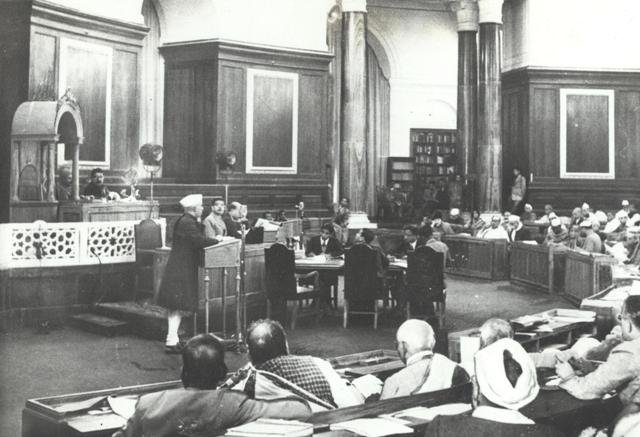
~ Pandit Jawaharlal Nehru
India’s journey from a British colony through the furnace of Partition to the adoption of the world’s longest written constitution is a monumental chapter in modern history. Formed under the Cabinet Mission Plan of 1946, the Constituent Assembly was tasked with architecting a new political order. Yet, the path was fraught with crisis, as the nation stood on the precipice of Partition, navigated the uncertainty of Princely State accession, and confronted severe socio-economic inequities across a vastly diverse population. Delivering this new order demanded a clear direction. On December 13, 1946, Pandit Jawaharlal Nehru introduced the ‘Objectives Resolution’, a guiding beacon designed to set the nation’s foundational goals. Today, the philosophy of that Resolution echoes throughout the constitutional text and forms the very spirit of the Preamble. Consequently, a thorough analysis of the Objectives Resolution becomes imperative to understand the basic structure of the Indian Constitution.
The Objectives Resolution
Introduced by Jawaharlal Nehru, the Objectives Resolution was never intended as a rigid legal framework or part of the Constitution. Instead, it served as a guiding vision capturing the core principles, democratic ideals, and fundamental values that India sought to guarantee its citizens following decades of colonial rule. By providing a clear ideological direction, it inspired the Assembly’s work and was unanimously adopted on January 22, 1947, in the following form:
“(1) This Constituent Assembly declares its firm and solemn resolve to proclaim India as an Independent Sovereign Republic and to draw up for her future governance a Constitution;
(2) WHEREIN the territories that now comprise British India, the territories that now form the Indian States, and such other parts of India as are outside British India and the States as well as such other territories as are willing to be constituted into the Independent Sovereign India, shall be a Union of them all; and
(3) WHEREIN the said territories, whether with their present boundaries or with such others as may be determined by the Constituent Assembly and thereafter according to the Law of the Constitution, shall possess and retain the status of autonomous Units, together with residuary powers, and exercise all powers and functions of government and administration, save and except such powers and functions as are vested in or assigned to the Union, or as are inherent or implied in the Union or resulting therefrom; and
(4) WHEREIN all power and authority of the Sovereign Independent India, its constituent parts and organs of government, are derived from the people; and
(5) WHEREIN shall be guaranteed and secured to all the people of India justice, social, economic and political; equality of status, of opportunity, and before the law; freedom of thought, expression, belief, faith, worship, vocation, association and action, subject to law and public morality; and
(6) WHEREIN adequate safeguards shall be provided for minorities, backward and tribal areas, and depressed and other backward classes; and
(7) WHEREBY shall be maintained the integrity of the territory of the Republic and its sovereign rights on land, sea, and air according to justice and the law of civilised nations, and
(8) This ancient land attains its rightful and honoured place in the world and make its full and willing contribution to the promotion of world peace and the welfare of mankind.”
Vision of Pandit Jawaharlal Nehru
When introducing the Objectives Resolution in December 1946, Jawaharlal Nehru envisioned it as a living philosophy meant to inspire the nation and breathe life into the Indian political order. He reflected on the great revolutions of America, France, and Russia, urging the Constituent Assembly to draw wisdom from their historical struggles, learning from their failures while striving to carry forward and even better their successes. Pandit Jawaharlal Nehru’s vision behind the introduction of the resolution can be understood broadly as:
- Anchor for Constitutional Makers: Nehru intended the resolution to act as a guiding compass rather than a restrictive legal framework. By deliberately keeping the language open ended, he avoided over regulating the assembly’s work, ensuring members had the freedom to draft a homegrown constitution. At the same time, by highlighting non-negotiable foundations, such as the necessity of a sovereign republic to achieve Purna Swaraj, he anchored the assembly to prevent an arbitrary approach to constitution making.
- Public Faith and Participation: Beyond establishing formal political principles, Nehru wanted the resolution to offer the Indian public a clear glimpse of the nation’s future ideals. By articulating a vision rooted in long standing Indian aspirations, he aimed to build trust, inspire faith, and invite the active participation of all citizens in establishing the new political order.
- Resolve to Avoid Unnecessary Delays: When faced with calls to postpone the resolution due to the absence of the Muslim League and representatives from princely states, Nehru insisted on immediate adoption. He argued that absenteeism should not stall their monumental task. To him, passing the resolution was an essential demonstration to the world of India’s authentic, unyielding resolve to affirm fundamental principles that were universally embraced across the nation.
Clause 1: Independent Sovereign Republic
In his address before the Constituent Assembly, Pandit Nehru made a crucial observation regarding India’s political identity: for India to be truly independent and sovereign in governing both its internal and external affairs, it had to be a republic. India could not have taken any other path than becoming a nation where supreme authority rests with the people, who in turn elect their head of state. India could not adopt a central monarchy, whether absolute or constitutional. A monarchy must stem from a clear historical or institutional source, which India lacked in a unified sense. Unlike nations like Canada and Australia, which retained the British monarch as their symbolic head of state, India rejected an external king because it demanded Purna Swaraj. At the same time, establishing a homegrown central monarchy was impossible. A local monarch cannot simply be chosen out of thin air, as it requires a single, continuous royal lineage across the entire territory. With over 500 distinct princely states, India had no single royal lineage to draw from, making any domestic monarchy completely impractical for a united nation.
Clause 2 & 3: Union & States
Clause 2 of the Objectives Resolution declared that India shall be a Union of the former British provinces, Princely States, and any other territories willing to join. This explicitly defined national boundary was an urgent necessity in 1946, a time when the accession of many Princely States remained uncertain and the threat of fragmentation loomed large. To reassure these regional units, Clause 3 guaranteed state autonomy over local matters and residual powers, except for those specifically vested in or inherent to the Union. However, this division of power was carefully crafted to give the central government a firm foothold in overall governance, ensuring it could decisively intervene against any separatist endeavors. Driven by the trauma of Partition and immense regional diversity, Dr. B.R. Ambedkar and the constitutional framers chose a quasi-federal, “holding together” model inspired by Canada rather than a decentralized “coming together” structure like the United States. By balancing state-level administrative autonomy with an overarching, powerful central authority, the Constitution successfully safeguarded national unity, prevented disintegration, and established a stable political framework for a newly independent nation
Clause 4: Sovereignty lies with the People
Clause 5: Justice, Equality and Fundamental Freedoms
- Preamble: Solemnly resolves to secure to all citizens justice, social, economic, and political.
- Article 38: Mandates the state to secure a social order for the promotion of the welfare of the people and to minimize inequalities in income, status, facilities, and opportunities.
- Article 39: Directs state policy toward securing adequate means of livelihood, equitable distribution of material resources, and prevention of concentration of wealth.
- Article 39A: Ensures equal justice and free legal aid to economically or otherwise disadvantaged citizens.
- Article 325: Guarantees political justice by prohibiting exclusion from electoral rolls based on religion, race, caste, or sex.
- Article 326: Ensures political democracy through universal adult suffrage for elections to the Lok Sabha and State Legislative Assemblies.
Equality of Status and Opportunity
- Article 14: Guarantees equality before the law and equal protection of the laws within the territory of India.
- Article 15: Prohibits state discrimination against any citizen on grounds only of religion, race, caste, sex, or place of birth.
- Article 16: Assures equality of opportunity for all citizens in matters relating to employment or appointment to any office under the state.
- Article 17: Abolishes untouchability and forbids its practice, enforcing equality of social status.
- Article 18: Abolishes titles to ensure egalitarian status among all citizens.
- Article 19(1)(a): Protects the freedom of speech and expression.
- Article 19(1)(b): Guarantees the right to assemble peaceably and without arms.
- Article 19(1)(c): Protects the right to form associations, unions, or co-operative societies.
- Article 19(1)(d): Guarantees the right to move freely throughout the territory of India.
- Article 19(1)(e): Protects the right to reside and settle in any part of the territory of India.
- Article 19(1)(g): Guarantees the right to practice any profession, or to carry on any occupation, trade, or business.
- Articles 19(2) to 19(6): Imposes reasonable restrictions on fundamental freedoms based on public order, decency, morality, law, and sovereignty.
- Article 25: Guarantees freedom of conscience and the right freely to profess, practice, and propagate religion, subject to public order, morality, and health.
- Article 26: Protects the freedom of every religious denomination to manage its own affairs in matters of religion.
- Article 27: Ensures freedom from payment of taxes for the promotion of any particular religion.
- Article 28: Guarantees freedom from compulsory attendance at religious instruction or religious worship in educational institutions.
Clause 6: Safeguards for Minorities, Backward Areas and Classes
Clause 6 of the Objectives Resolution provided for adequate safeguards for minorities, backward and tribal areas, and the depressed and other backward classes, a commitment that is reflected in the present Constitution through the following provisions:
Safeguards for Backward Classes
- Article 15(4): Special provisions for educational advancement of SEBCs, SCs, and STs.
- Article 15(5): Reservations for SEBCs, SCs, and STs in private educational institutions.
- Article 16(4): Reservations in public employment for inadequately represented backward classes.
- Article 16(4A) and 16(4B): Reservations in promotions and carry forward of unfilled backlog seats for SCs and STs.
- Article 17: Abolition of untouchability and prohibition of its practice.
- Article 46: Directs the state to promote educational and economic interests of SCs, STs, and weaker sections.
- Articles 243D and 243T: Mandatory reservation of seats for SCs, STs, and women in Panchayats and Municipalities.
- Articles 330 and 332: Reservation of seats for SCs and STs in Lok Sabha and State Legislative Assemblies.
- Article 335: Claims of SCs and STs to be considered in public service appointments alongside administrative efficiency.
- Articles 338, 338A, and 338B: Constitutional commissions to monitor SC, ST, and BC safeguards.
- Article 340: Presidential power to appoint a commission to investigate backward class conditions.
- Article 19(5): Reasonable restrictions on movement and residence to protect Scheduled Tribe interests.
- Article 244(1) and Fifth Schedule: Protection of tribal lands, regulation of money lending, and creation of Tribes Advisory Councils in Scheduled Areas.
- Article 244(2), 275(1), and Sixth Schedule: Autonomous District Councils with legislative, judicial, and executive powers in tribal areas of Assam, Meghalaya, Tripura, and Mizoram.
- Article 275(1): Central grants in aid to states for tribal welfare and upgrading Scheduled Area administration.
- Articles 371A to 371J: Special provisions for administrative autonomy and protection of local customs and land rights in specific states and regions.
Safeguards for Minorities
- Articles 15(1) and 16(2): Prohibition of discrimination based on religion, race, caste, sex, or place of birth in public domains and employment.
- Articles 25 to 28: Rights to freedom of conscience, religious practice, propagation, management of religious affairs, and protection from forced religious instruction or taxation.
- Article 29: Right of any section of citizens to conserve a distinct language, script, or culture, and non-discrimination in state funded educational admissions.
- Article 30: Right of religious and linguistic minorities to establish and administer educational institutions without state discrimination in funding.
- Article 347: Official recognition of languages spoken by minority populations upon presidential direction.
- Article 350A: Primary education instruction in the mother tongue for linguistic minority children.
- Article 350B: Special Officer for Linguistic Minorities to investigate constitutional safeguard compliance.
Clause 7: Sovereignty Rights on Land, Sea and Air
- Article 1: Defines India as a Union of States and specifies the territory of India, including state territories, Union territories, and acquired territories.
- Article 297: Specifies that all lands, minerals, and other things of value underlying the ocean within the territorial waters, continental shelf, or exclusive economic zone vest in the Union.
- Article 51(c): Directs the state to foster respect for international law and treaty obligations in the dealings of organized peoples with one another.
- Article 352: Enables the proclamation of a National Emergency if the security of India or any part of its territory is threatened by war, external aggression, or armed rebellion.
- Territorial Waters, Continental Shelf, Exclusive Economic Zone and other Maritime Zones Act, 1976: Defines and asserts Indian sovereignty, jurisdiction, and rights over its internal waters, territorial sea, contiguous zone, continental shelf, and Exclusive Economic Zone.
- Maritime Zones of India (Regulation of Fishing by Foreign Vessels) Act, 1981: Regulates and prevents illegal foreign fishing within India’s maritime zones to protect sovereign resources and security.
- Aircraft Act, 1934: Regulates the control of manufacture, possession, use, operation, sale, import, and export of aircraft, asserting complete sovereign jurisdiction over Indian airspace.
- Bharatiya Nyaya Sanhita, 2023 (Section 152): Penalizes acts threatening the sovereignty, unity, and integrity of India.
- United Nations Convention on the Law of the Sea (UNCLOS), 1982: India adheres to UNCLOS rules on sovereign rights over territorial seas, baseline delimitations, innocent passage, and resource rights in the Exclusive Economic Zone.
- Chicago Convention on International Civil Aviation, 1944: India is a signatory to the Chicago Convention, which recognizes that every state has complete and exclusive sovereignty over the airspace above its territory.
- United Nations Charter, 1945 (Article 2(4)): Requires members to refrain from the threat or use of force against the territorial integrity or political independence of any state.
Clause 8: Contribution to World Peace & Welfare of Mankind
India’s emergence from colonial suppression and its rebirth through the crucible of the freedom struggle laid the foundation for building a sovereign nation from scratch. Over the past decades, India has shaped its global presence by empowering its citizens while simultaneously serving mankind through steadfast contributions to international peace and environmental protection. India’s global footprint rests on its civilizational ethos, translating ancient philosophical wisdom into modern international law, diplomacy, and global governance:
- Peaceful Diplomacy and Welfare: Anchored in the core principle of non violence, India maintains global peace through United Nations peacekeeping, deploying over 290,000 personnel across more than 50 missions. Through emergency relief, medical supplies, and pioneering all women peacekeeping units in regions like Abyei and the Democratic Republic of Congo, India combines humanitarian service with gender inclusion to safeguard human dignity worldwide.
- Ecological Stewardship and Equitable Technology: Guided by the vision that the world is one family, India treats climate change as a shared collective responsibility by co founding global clean energy alliances and promoting sustainable living practices. In the digital domain, India views technological progress as a public good, sharing its accessible digital public infrastructure and financial systems with developing nations to foster global economic inclusion.
- Pluralistic Governance and Global Equity: Drawing from its own constitutional tradition of unity in diversity, India champions an inclusive international order that respects cultural pluralism and safeguards vulnerable populations. Through multilateral platforms, India serves as a vital bridge between nations, amplifying the voices of the Global South through international capacity building programs, specialized training at the Centre for United Nations Peacekeeping, and persistent advocacy for fair climate finance, debt restructuring, and equitable institutional reforms.
Preamble & The Basic Structure
- (1973) 4 SCC 225.